
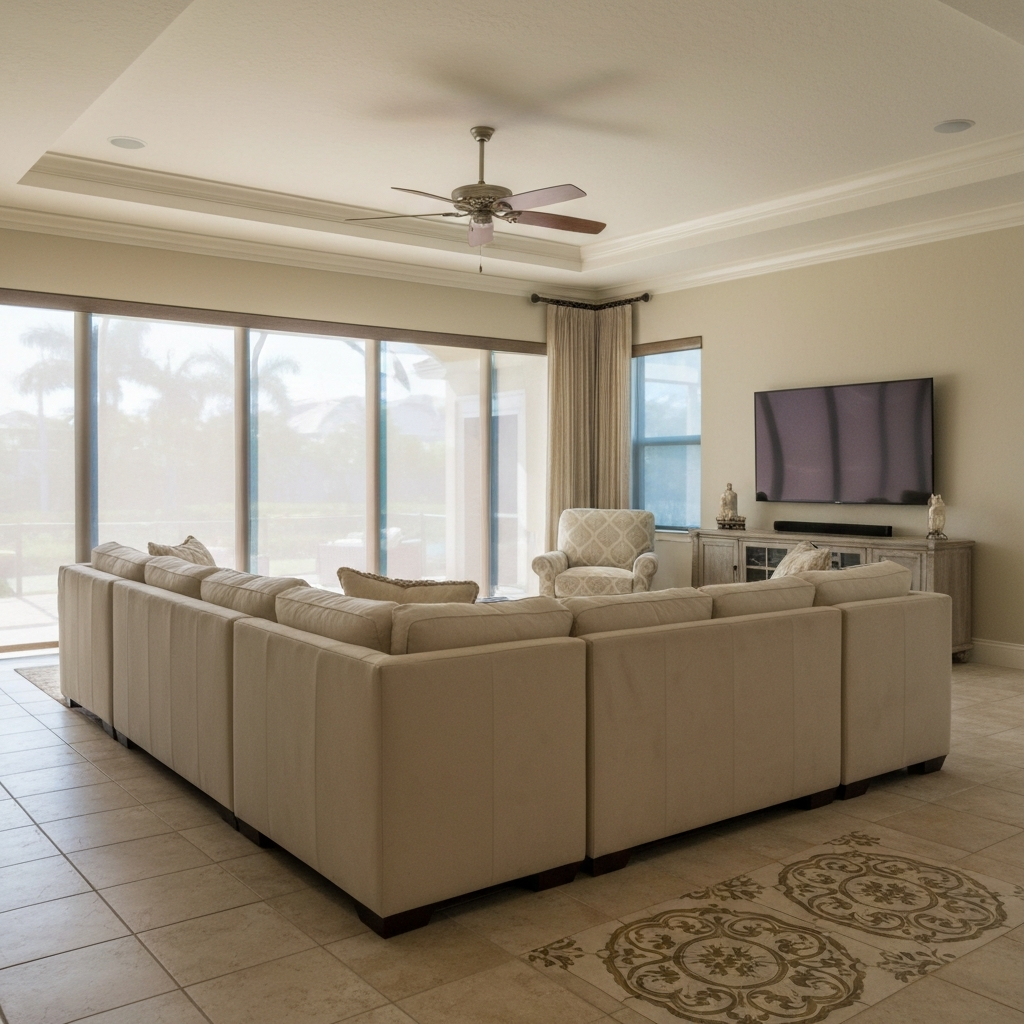
Best Window Treatments for Large Sliding Glass Doors
Large sliding glass doors bring in natural light and connect your home to the outdoors. They can also create glare, heat, privacy concerns, and difficult-to-cover openings.
This guide compares practical window-treatment options so you can choose the right fit for your room, door, view, and daily routine.
The Quick Answer
The best treatment depends on how you use the door.
Vertical blinds are often a practical choice for doors that are opened frequently because they move from side to side and can be opened only where access is needed.
Roller and solar shades can provide a cleaner, more minimal appearance. Solar shades may help control glare while preserving more of the outdoor view, while room-darkening roller shades can provide stronger light and privacy control.
Panel-track shades may work well on very wide openings. Motorized shades can make large or hard-to-reach doors easier to manage. Plantation shutters may be considered when the homeowner wants a built-in, furniture-like appearance.
Before choosing, consider privacy, sunlight, heat, door traffic, furniture placement, view preservation, and how often the treatment will be opened.
| Option | Best For | Main Consideration |
|---|---|---|
| Vertical blinds | Frequent door use | Practical side-to-side access |
| Roller shades | Clean, simple appearance | May cover the full opening at once |
| Solar shades | Glare control and preserving views | Privacy varies by fabric |
| Cellular shades | Softer light and added comfort near glass | Requires the correct door configuration |
| Panel-track shades | Very wide openings | Needs stacking space when open |
| Motorized shades | Convenience and large openings | Higher cost and power planning |
| Plantation shutters | Built-in appearance | Requires careful panel design |
What Makes Sliding Glass Doors Hard to Cover?
Sliding glass doors are wider and used differently than standard windows.
A treatment that works well on a bedroom window may feel heavy, awkward, or difficult to operate across a large door. The size of the opening also affects product weight, hardware, control options, and how much wall or floor space is needed.
Common challenges include:
- Wide glass openings
- Strong afternoon sunlight
- Glare on televisions and screens
- Heat entering the room
- Limited privacy at night
- Frequent foot traffic
- Door handles and frames
- Furniture close to the opening
- The need to preserve an outdoor view
- Children or pets using the doorway
- Tall or hard-to-reach glass
- Multiple moving door panels
The right solution needs to fit both the glass and the way the room functions.
Vertical Blinds for Sliding Glass Doors
Vertical blinds are one of the most familiar choices for sliding glass doors because they move in the same direction as the door.
They can be opened partially for access, tilted for privacy, or moved fully to one side. This makes them practical for patio doors that are used throughout the day.
Modern vertical blinds are available in cleaner materials, colors, and finishes than older builder-grade products. The final look depends heavily on vane quality, track design, color selection, and professional installation.
Advantages
- Easy side-to-side operation
- Practical for doors used every day
- Adjustable light and privacy
- Available in several materials and colors
- Can cover wide openings
- Allows partial access to the door
- Familiar and straightforward operation
Possible Drawbacks
- Individual vanes may move in strong airflow
- Lower-quality systems can look dated
- Damaged vanes may require replacement
- Tracks need enough clearance
- Furniture can interfere with the stacking area
- Some homeowners prefer a softer or more minimal appearance
Roller Shades for Sliding Glass Doors
Roller shades provide a clean, simple appearance and are available in light-filtering, room-darkening, decorative, and solar fabrics.
For a large sliding door, the opening may be covered by one large shade or divided into multiple shades. The best layout depends on the width of the opening, which door panel moves, fabric weight, product limits, and how often each section needs to be opened.
A divided design can sometimes provide better access because one shade can be raised while another remains lowered for privacy or glare control.
Advantages
- Clean, minimal design
- Wide choice of fabrics
- Strong glare-control options
- Manual and motorized controls
- Can coordinate with nearby windows
- Available in light-filtering and room-darkening materials
- Works well in modern and transitional interiors
Possible Drawbacks
- A very large single shade may be heavy
- One full-width shade may block door access when lowered
- Multiple shades require careful alignment
- Fabric choice affects privacy and view
- The roll and hardware need enough mounting space
- Wind or airflow may affect some installations when doors are open
Solar Shades for Bright Sliding Doors
Solar shades are designed to reduce glare and manage strong sunlight while allowing some view through the fabric.
They may be useful for sliding doors facing patios, pools, water, golf courses, or other bright outdoor spaces. They can make a living room or family room more comfortable without completely removing the visual connection to the outdoors.
Fabric openness affects how much light, glare, privacy, and view the shade provides. A more open fabric may preserve more of the view, while a tighter fabric may reduce more light and improve daytime privacy.
Advantages
- Helps reduce glare
- Can preserve more of the outdoor view
- Clean, simple appearance
- Useful for bright living and family rooms
- Available with manual or motorized controls
- Can coordinate with solar shades on nearby windows
- Helps soften harsh direct sunlight
Possible Drawbacks
- Solar shades are not always a strong nighttime privacy solution.
- When indoor lights are on after dark, visibility through some solar fabrics may increase. The result depends on fabric openness, color, indoor lighting, outdoor lighting, and distance from the glass.
- Homeowners who need strong nighttime privacy may want to consider an opaque roller shade, cellular shade, vertical blind, shutter system, or layered solution.
Cellular Shades for Sliding Glass Doors
Cellular shades use a honeycomb-shaped fabric design that can soften light and add a layer of insulation at the glass.
Specialty vertical cellular systems may be available for sliding doors. Instead of lifting from the bottom like a standard window shade, these systems open from side to side.
This can provide a softer look than traditional vertical blinds while still allowing access to the door.
Advantages
- Softer appearance
- Good privacy options
- Light-filtering and room-darkening fabrics
- Added comfort near large areas of glass
- Cleaner look than standard vertical blinds
- Side-to-side operation on specialty systems
- Can work well in bedrooms and living spaces
Possible Drawbacks
- Specialty systems may cost more
- Fabric requires appropriate care
- Not every cellular product is designed for doors
- Professional measuring is especially important
- Door handles and trim may affect the configuration
- Large systems may require careful product selection
Panel-Track Shades for Wide Openings
Panel-track shades use wide fabric panels that slide along a track.
They are designed for broad openings and can create a clean, modern look. The panels may stack to one side or split from the center, depending on the system and the way the sliding door operates.
Panel-track systems can also coordinate visually with roller shades used on nearby windows because similar fabrics may be available across both product categories.
Advantages
- Designed for wide openings
- Large range of fabrics and textures
- Smooth side-to-side operation
- Can coordinate with roller shades
- Modern appearance
- Works well for wide patio doors
- Allows partial or full coverage
Possible Drawbacks
- Panels need stacking space
- Furniture placement can affect operation
- Large panels may require more wall clearance
- Fabric selection affects privacy and glare control
- The track system must align with the door layout
- Some configurations may partially cover the glass when open
Motorized Shades for Sliding Glass Doors
Motorization can make large shades easier to use, especially when the door is wide, frequently adjusted, located behind furniture, or difficult to reach.
Depending on the product, controls may include a remote, wall switch, app, timer, or compatible smart-home system.
Motorization may be especially helpful when multiple shades cover one large opening. The shades may be operated individually or together, depending on the control system.
Advantages
- Easier control across large openings
- Helpful for tall or difficult installations
- Can operate multiple shades together
- Useful for daily glare and privacy routines
- Reduces repeated manual handling
- May integrate with compatible smart-home systems
- Can improve convenience in rooms used throughout the day
Important Planning Points
- Power source
- Battery or hardwired operation
- Shade size and weight
- Remote and app compatibility
- Smart-home compatibility
- Access for charging or service
- Whether multiple shades should move together
- Product and fabric limitations
- Placement of furniture and outlets
Plantation Shutters for Sliding Doors
Plantation shutters can provide a built-in, furniture-like appearance for some sliding glass doors.
Depending on the opening, the design may use bypass panels that slide behind one another or hinged panels that fold away. The system must be planned around door access, panel movement, handles, and nearby furniture.
Shutters may be especially appealing when nearby windows already have shutters and the homeowner wants a coordinated appearance.
Advantages
- Strong privacy and light control
- Durable, finished appearance
- Adjustable louvers
- Long-term design value
- Can coordinate with shutters on nearby windows
- Built-in architectural look
- No fabric to raise or lower
Possible Drawbacks
- Requires space for panels
- Door access must be planned carefully
- Usually a larger investment
- Panel movement and furniture placement matter
- Some of the glass may remain covered when panels are stacked
- The correct track or hinge design is essential
Which Option Is Best for Privacy?
Privacy depends on the material, fabric, louver position, room lighting, and whether the room is viewed during the day or at night.
For stronger privacy, consider:
- Opaque roller shades
- Room-darkening shades
- Cellular shades
- Closed vertical blinds
- Plantation shutters
- Layered window treatments
Solar shades may preserve the view during the day, but some fabrics provide less privacy after dark when indoor lights are on.
The room also matters. A living room facing a private backyard may have different needs than a bedroom or first-floor family room facing a street.
Explore privacy-focused window treatments that preserve natural light and bedroom window treatments for privacy and light control.
Which Option Is Best for Heat and Glare?
Large glass doors can bring strong heat and glare into living rooms, family rooms, dining areas, bedrooms, and home offices.
Solar shades can help manage glare while preserving more of the view.
Room-darkening roller shades and cellular shades can provide stronger light reduction. Plantation shutters and vertical blinds allow adjustable control by changing the angle of the louvers or vanes.
The result depends on:
- Window direction
- Time of day
- Glass type
- Fabric openness
- Fabric color
- Material
- Distance from the glass
- Whether the treatment covers the full opening
- Whether preserving the view is important
No single treatment provides the same result in every room.
Homeowners dealing with strong sunlight may also want to explore window treatments for hot Florida rooms, ways to protect interiors from sun exposure, and the best window treatments for bright living rooms.
Which Option Is Easiest to Use Every Day?
The easiest treatment depends on how often the door is used and how the room is arranged.
For Doors Opened Many Times Per Day
Vertical blinds or panel-track systems may provide easier side-to-side access. These systems can often be moved only as far as needed to reach the active door panel.
For a Clean, Simple Look
Roller shades may be a strong fit. They provide a minimal appearance and can coordinate with shades on nearby windows.
For Glare Without Losing the View
Consider solar shades. The correct fabric can reduce glare while maintaining more visual connection to the patio, pool, yard, or water view.
For Stronger Privacy and Softer Light
Consider cellular or room-darkening shades. These options can provide more privacy and reduce more light than many solar fabrics.
For Convenience
Consider motorized shades. Motorization may be helpful when shades are large, frequently adjusted, behind furniture, or difficult to operate manually.
For a Built-In Appearance
Consider plantation shutters. Shutters may provide a more architectural look, but panel movement and door access must be planned carefully.
One Large Treatment or Multiple Sections?
A large sliding door does not always need one full-width treatment.
Dividing the opening into two or three sections may:
- Make treatments easier to operate
- Allow access to one side of the door
- Reduce fabric or product weight
- Create better control over light and privacy
- Make repairs or replacement simpler
- Allow one section to remain lowered while another is open
- Better match the individual door panels
The best layout depends on:
- The total width of the opening
- The number of door panels
- Which panel moves
- How frequently the door is used
- Product size limits
- Fabric or material weight
- Whether the treatment is manual or motorized
- The desired symmetry
- Furniture placement
Professional measuring helps identify whether one large treatment or multiple sections will operate more smoothly.
What Florida Homeowners Should Consider
Florida sliding doors often face strong sunlight, heat, humidity, outdoor views, patios, pools, and coastal conditions.
Before choosing a treatment, consider:
- Which direction the door faces
- How much direct sun reaches the glass
- Whether you want to preserve the view
- Daytime and nighttime privacy
- How often the door is used
- Humidity and easy cleaning
- Children and pets
- Furniture placement
- Manual or motorized operation
- Salt air in coastal areas
- Whether the door is opened for airflow
- How the treatment coordinates with nearby windows
A west-facing sliding door may need stronger afternoon glare control. A door facing a private backyard may allow a more open solar fabric than a street-facing door.
Homes near the coast may also benefit from materials and hardware that are easier to maintain.
Those Blind Guys serves homeowners throughout Duval, St. Johns, and Nassau Counties.
How Much Do Sliding-Door Window Treatments Cost?
Pricing depends on the width and height of the opening, product type, fabric or material, number of panels, controls, motorization, installation, and custom features.
A simple vertical blind may cost less than a motorized roller shade or custom shutter system. However, the final price depends on the actual product and door configuration.
Pricing factors may include:
- Door width and height
- Number of glass panels
- Product type
- Fabric or material
- Number of treatment sections
- Manual or motorized controls
- Battery or hardwired power
- Decorative hardware
- Track configuration
- Specialty mounting requirements
- Professional measuring
- Installation
The most useful way to compare options is to review samples and measurements for the actual door rather than rely on generic online pricing.
Frequently Asked Questions
Helpful answers for homeowners comparing sliding glass door treatments.
Compare Sliding Glass Door Options in Your Home
Large sliding doors require the right balance of access, privacy, glare control, and appearance. Schedule a free in-home consultation to compare materials, fabrics, operating systems, panel configurations, and motorized options for your door. The goal is to choose a treatment that works with the way you use the room—not simply cover the glass.