
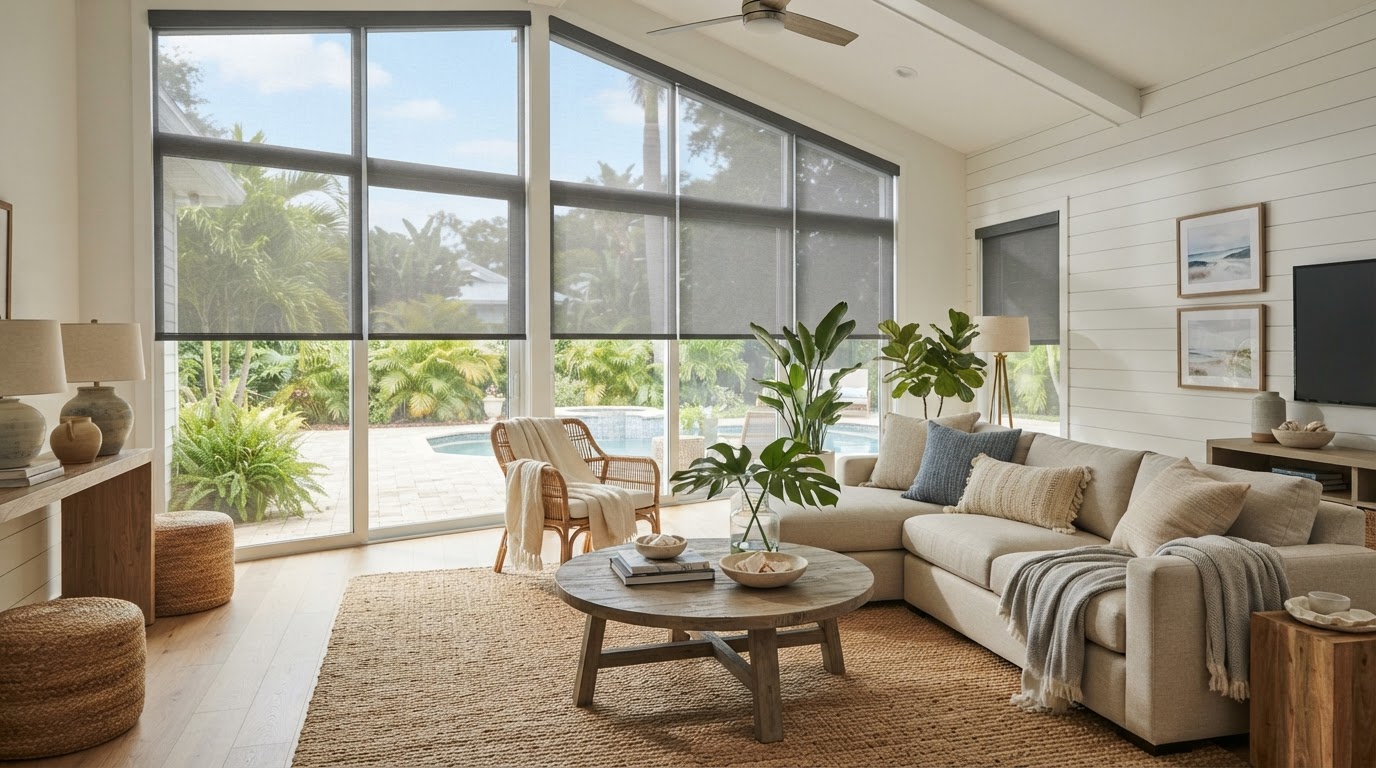
Solar Shades vs. Light-Filtering Shades for Bright Florida Rooms
Bright Florida rooms can feel open and inviting, but strong sunlight may also create glare, heat, faded furnishings, and privacy concerns. Solar shades and light-filtering shades both soften sunlight, but they do it in different ways. This guide explains how each option works and where each one may fit best.
The Quick Answer
Choose solar shades when glare control and preserving the outdoor view are the main goals.
Choose light-filtering shades when you want softer natural light, more daytime privacy, and a warmer indoor appearance.
Solar shades are often useful in bright living rooms, offices, sunrooms, and spaces with large windows. Light-filtering shades are often a better fit for bedrooms, dining rooms, family rooms, and spaces where comfort and privacy matter more than keeping the view.
| Factor | Solar Shades | Light-Filtering Shades |
|---|---|---|
| Glare reduction | Usually stronger | Moderate |
| Outdoor view | Better preserved | More softened |
| Daytime privacy | Depends on fabric openness | Usually stronger |
| Nighttime privacy | Often limited | Usually better, but varies |
| Natural light | More controlled | Softer and more diffused |
| Heat management | Often stronger | Moderate |
| Decorative appearance | Clean and minimal | Wider fabric and texture choices |
Neither option is right for every room. The better choice depends on window direction, privacy needs, the outdoor view, room use, and the look you want inside the home.
What Are Solar Shades?
Solar shades are made from screen-like fabrics designed to reduce glare and manage strong sunlight while allowing some visibility through the material.
They are often chosen for rooms with large windows, strong afternoon sun, televisions, computer screens, or outdoor views homeowners want to keep.
Instead of covering the view with an opaque fabric, a solar shade filters the sunlight entering the room. The exact result depends on the fabric color, weave, openness, window direction, and lighting conditions.
Main Benefits of Solar Shades
Solar shades may be a strong fit when you want to:
- Reduce glare on televisions and computer screens
- Manage strong direct sunlight
- Preserve more of the outdoor view
- Create a clean, simple appearance
- Cover wide windows
- Coordinate several windows with the same fabric
- Use manual or motorized controls
- Keep a room bright without leaving the glass completely uncovered
Solar shades can work especially well in modern living rooms, home offices, sunrooms, and rooms facing patios, pools, water, or open outdoor spaces.
Possible Drawbacks
Solar shades also have important tradeoffs:
- Privacy may be limited, especially at night
- The room may still feel bright
- Fabric openness changes the level of glare control
- They are often more functional than decorative
- Darker fabrics may change the visual feel of the room
- More open fabrics preserve views but may allow more light
- Tighter fabrics improve control but may soften the view
Homeowners who need strong nighttime privacy may need a tighter fabric, a second treatment, or a different shade type.
Explore roller shades, motorized shades, and Norman roller shades in Jacksonville.
What Are Light-Filtering Shades?
Light-filtering shades soften sunlight rather than blocking it completely.
They allow natural light into the room while reducing harsh brightness and creating a more comfortable indoor glow. Depending on the fabric, they can also provide stronger privacy than solar shades.
Light-filtering fabrics are available across several shade styles, including roller shades and other fabric-based window treatments. Their appearance may range from smooth and minimal to woven, textured, or decorative.
Main Benefits of Light-Filtering Shades
Light-filtering shades may be a strong choice when you want to:
- Soften bright sunlight
- Add daytime privacy
- Create a warmer indoor feel
- Choose from more colors and textures
- Coordinate the shades with furniture and décor
- Keep the room from feeling too dark
- Use them in living rooms, bedrooms, dining rooms, or family rooms
- Create a softer alternative to bare glass
These shades are often chosen when the homeowner wants comfort, privacy, and natural light without preserving a clear outdoor view.
Possible Drawbacks
Light-filtering shades also have limitations:
- They may not reduce glare as strongly as solar shades
- They may not preserve the outdoor view
- Some fabrics may allow shapes or shadows to be seen at night
- They are not the same as blackout shades
- They are not the same as room-darkening shades
- Fabric color and density affect the result
- Strong direct sunlight may still feel bright through some materials
Explore custom shades, roller shades, and privacy-focused window treatments.
How Fabric Openness Changes Solar Shade Performance
Solar shade fabrics are often described by an openness percentage.
A lower openness percentage usually means a tighter fabric weave. This can provide stronger glare control, a more filtered view, and more privacy.
A higher openness percentage usually means a more open weave. This can preserve a clearer outdoor view, but it may allow more sunlight and reduce privacy.
| Openness | Typical Result |
|---|---|
| Lower openness | More glare control and privacy |
| Medium openness | Balanced view and light control |
| Higher openness | Better view with less privacy |
The right openness depends on:
- Window direction
- Strength of the sunlight
- Time of day
- Outdoor view
- Daytime privacy needs
- Nighttime privacy needs
- Whether the room has a television or computer screen
- Whether the fabric is light or dark
- How the room is used
A west-facing living room may need a different fabric than a north-facing office. A patio-facing room with a private backyard may also allow a more open fabric than a street-facing room. There is no single openness percentage that is best for every home. Product recommendations should be based on the actual room and the manufacturer's specifications.
Which Option Is Better for Glare?
Solar shades are usually the stronger choice when glare is the main problem. They can be especially helpful in:
- Living rooms with televisions
- Home offices with computer screens
- Rooms with west-facing windows
- Bright family rooms
- Sunrooms
- Spaces with large areas of glass
- Rooms facing water, pools, or open outdoor areas
Solar fabrics are designed to manage strong sunlight while keeping the room visually connected to the outdoors. Light-filtering shades can still soften brightness, but they may not control sharp glare as effectively. Their main strength is creating a softer, more diffused indoor light.
For rooms where glare makes it hard to relax, watch television, or work, explore window treatments for hot Florida rooms, bright living-room window treatments, and glare-control options for Nocatee homes. You can also learn more about helping protect floors and furniture from strong Florida sunlight.
Which Option Is Better for Privacy?
Light-filtering shades usually provide more privacy than solar shades, especially during the day. Their fabric softens the view through the window and makes it more difficult to see clearly into the room. The exact level of privacy depends on the material, color, density, and lighting conditions.
Solar shades may allow homeowners to see outside while reducing visibility from the exterior during daylight. However, after dark, the effect can reverse when indoor lights are on. That makes solar shades less reliable as a standalone nighttime privacy solution.
For stronger nighttime privacy, consider:
- A tighter light-filtering fabric
- An opaque roller shade
- A room-darkening shade
- A layered window treatment
- Decorative side panels
- A second treatment used after dark
No fabric should be treated as providing complete privacy unless the exact product and lighting conditions support that claim.
Explore ways to create privacy without making the room dark and compare bedroom treatments for privacy and light control.
Which Option Is Better for Florida Heat?
Solar shades are often chosen for rooms with strong direct sunlight because their fabrics are designed to manage glare and solar exposure. Light-filtering shades can still improve comfort by softening sunlight, but they usually place more emphasis on appearance, privacy, and diffused light.
The way a room feels depends on several factors:
- Window direction
- Glass type
- Time of day
- Fabric color
- Fabric openness
- Shade placement
- Size of the glass
- Whether the shade covers the full opening
- Whether the room has several exposed windows
A west-facing living room with large glass may need a different solution than a bedroom with indirect morning light. Solar shades may help make a bright room easier to enjoy, but exact temperature or energy savings should not be promised without product-specific testing.
Learn more about shades for hot Florida rooms and ways to protect interiors from sunlight.
Which Option Preserves the View?
Solar shades are usually the better option when maintaining the outdoor view matters. The amount of view depends on the fabric openness and the lighting conditions. Higher-openness fabrics preserve more of the view but generally provide less privacy and glare control. Lower-openness fabrics create more visual filtering and stronger control, but they soften the view.
Light-filtering shades usually blur or obscure the outdoor view because the fabric is designed to diffuse light instead of remain see-through.
View preservation may be especially important in:
- Coastal homes
- Rooms facing water
- Pool-facing living rooms
- Patio-facing family rooms
- Large living-room windows
- Sliding glass doors
- Golf-course or preserve views
Explore the best window treatments for coastal homes, guidance for Jacksonville Beach coastal light, and treatments for large sliding glass doors.
Which Option Looks More Decorative?
Light-filtering shades usually offer more decorative choices. They may be available in a wider range of:
- Colors
- Textures
- Woven materials
- Soft fabrics
- Neutral patterns
- Decorative finishes
- Materials that coordinate with furniture and flooring
Solar shades usually have a cleaner, more modern, and more functional appearance. They can work well in contemporary rooms, offices, sunrooms, and homes where preserving the view matters more than adding fabric texture.
The best choice depends on what matters most: design, view preservation, glare control, privacy, softness, simplicity, or coordination with nearby windows.
For more decorative options, explore woven wood shades and other custom window treatments.
Best Choice by Room
Best Choice for Living Rooms
Solar shades may be a strong fit for living rooms with bright windows, televisions, large glass, or outdoor views. They can reduce glare while keeping more of the room's connection to the outside.
Light-filtering shades may be better when the goal is softer light, street-facing privacy, and a more decorative appearance.
Important decision factors include:
- Television glare
- Afternoon sun
- Street-facing privacy
- Outdoor view
- Furniture and flooring exposure
- Room design
- Whether nighttime privacy is needed
- Whether the space should feel modern or soft
Some living rooms may benefit from layering a solar shade with decorative side panels or another treatment.
Best Choice for Bedrooms
Light-filtering shades usually make more sense than solar shades in bedrooms because privacy is often more important than preserving the view. They can soften morning sunlight and create a more comfortable atmosphere.
However, light-filtering shades are not blackout shades. Homeowners who need a darker room should consider room-darkening or blackout fabrics.
Bedroom decisions should consider:
- Morning sunlight
- Nighttime privacy
- Street or neighbor visibility
- Sleep schedule
- Room-darkening needs
- Fabric color
- Whether a layered treatment is needed
Explore bedroom window treatments for privacy and light control.
Best Choice for Home Offices
Solar shades are often useful in home offices because they reduce screen glare while keeping some natural light and outdoor visibility. They may be especially helpful for west-facing windows or workspaces with several hours of direct sun.
Light-filtering shades may work better where softer light, decorative fabric, and privacy are more important than a clear view.
Consider:
- Screen position
- Window direction
- Video-call privacy
- How often the shade is adjusted
- Whether the window is hard to reach
- Whether glare changes throughout the day
Explore solutions for hard-to-reach windows and convenient motorized shades.
Best Choice for Dining Rooms
Light-filtering shades often work well in dining rooms because they create softer light and offer more decorative fabric choices. Their colors and textures can coordinate with dining furniture, flooring, wall color, and nearby living spaces.
Solar shades may be useful when the room has strong afternoon sun or a view the homeowner wants to preserve.
The better choice depends on whether the priority is:
- Softer atmosphere
- Decorative appearance
- Privacy
- Glare control
- Outdoor view
- Coordination with nearby rooms
Best Choice for Large Windows and Sliding Doors
Solar shades are commonly used on large windows because they create a clean look and help control glare. Light-filtering roller shades may also work, especially when privacy and softer light matter more than the view.
For very wide openings, the treatment may need to be divided into multiple shades. This can make operation easier, reduce product weight, and allow one section to be opened while another remains lowered.
Large-window decisions should consider:
- Total width and height
- Fabric weight
- Product limits
- Which portion needs to open
- Manual or motorized controls
- Alignment between multiple shades
- Furniture placement
- Access to doors
Explore sliding glass door window treatments, roller shades, and motorized shades.
Best Choice for Coastal Homes
Coastal homes often have bright sunlight, open views, large windows, and rooms that feel visually connected to the outdoors.
Solar shades may help control glare without completely covering the view. This can make them useful in living rooms, sunrooms, and patio-facing spaces. Light-filtering shades may be better for rooms where privacy, softness, and decorative fabric matter more than preserving the view.
Coastal-home considerations include:
- Bright sunlight
- Water or preserve views
- Large windows
- Daytime privacy
- Nighttime privacy
- Easy cleaning
- Room direction
- Whether the room is used during the brightest part of the day
Explore window treatments for coastal homes, bright coastal homes in Fernandina Beach, and guidance for Jacksonville Beach coastal light.
How to Choose Between Solar and Light-Filtering Shades
Choose Solar Shades When:
- Glare is the biggest concern
- You want to preserve the outdoor view
- The room has strong direct sunlight
- The window is large
- The room has televisions or computer screens
- You prefer a clean, modern look
- Daytime view matters more than nighttime privacy
Choose Light-Filtering Shades When:
- Privacy is more important
- You want softer natural light
- You want more fabric, color, or texture choices
- The room should feel warmer and more comfortable
- The outdoor view is not the main priority
- You do not need blackout performance
- You want the shade to feel connected to the room's design
Consider Layering When:
- You want a daytime view and stronger nighttime privacy
- You need different levels of control throughout the day
- You want a more decorative finish
- One treatment cannot meet every need
- The room has both glare and privacy concerns
- You want a solar shade during the day and another layer after dark
Can Solar and Light-Filtering Shades Be Motorized?
Many roller-style solar and light-filtering shades can be motorized, depending on the product, size, and installation.
Motorization may be helpful for:
- Tall windows
- Wide windows
- Hard-to-reach openings
- Frequently adjusted shades
- Groups of windows
- Scheduled glare control
- Shades located behind furniture
- Rooms where several shades should move together
Depending on the product, controls may include a remote, wall switch, app, timer, or compatible smart-home system.
The planning process should consider:
- Shade size
- Fabric weight
- Battery or hardwired power
- Access for charging or service
- Product compatibility
- Remote and app options
- Whether several shades should operate together
Explore motorized shades, Norman motorized shades in Jacksonville, and the differences between motorized and manual shades.
How Much Do Solar and Light-Filtering Shades Cost?
Pricing depends on window size, fabric, openness, controls, motorization, number of shades, and installation.
Solar and light-filtering shades may use similar roller systems, but fabric selection and added features can change the final project cost.
Cost factors may include:
- Window width and height
- Fabric type
- Openness percentage
- Manual or motorized controls
- Number of windows
- Number of shades per opening
- Specialty shapes
- Decorative hardware
- Mounting requirements
- Professional measuring
- Installation
A large motorized solar shade may have a different project cost than a manually operated light-filtering shade on a smaller window. The most accurate way to compare options is to review fabrics and measurements for the actual room rather than rely on general online pricing.
Frequently Asked Questions
Helpful answers for homeowners comparing solar and light-filtering shades.
Compare Shade Fabrics in Your Home
Solar and light-filtering fabrics can look very different depending on the room, window direction, outdoor view, and time of day. Schedule a free in-home consultation to compare fabrics, opacity, glare control, privacy, colors, and control options in your actual space. The goal is to choose a shade that makes the room easier to enjoy—not simply cover the window.
Call 904-944-9596