
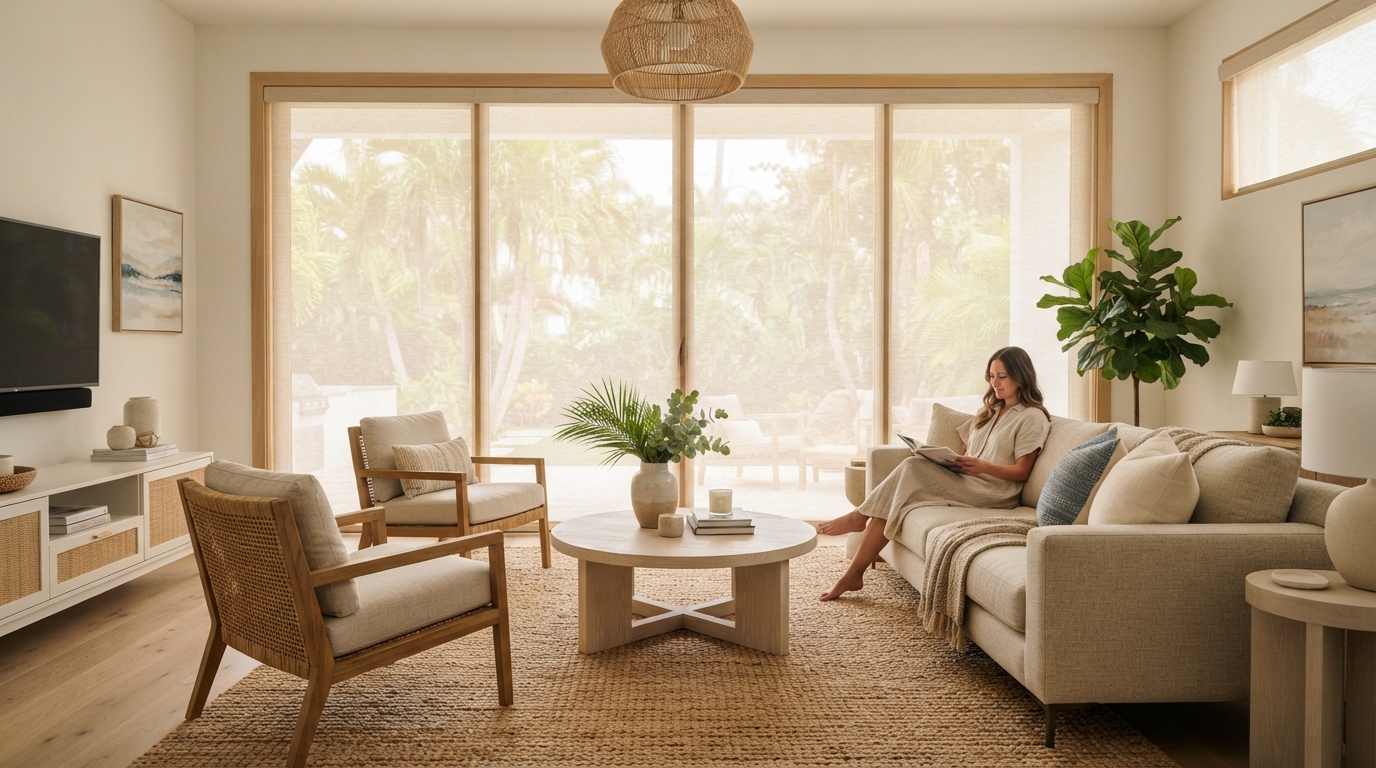
How to Get Privacy Without Making a Room Feel Dark
Privacy does not have to mean closing every window and turning on the lights during the day. The right window treatment can reduce outside views, soften harsh sunlight, and keep a room feeling bright and comfortable. The best option depends on the room, window direction, time of day, and level of privacy you need.
The Quick Answer
Light-filtering shades, cellular shades, adjustable blinds, plantation shutters, and layered treatments can all improve privacy without making a room feel dark.
The right choice depends on whether you need daytime privacy, nighttime privacy, glare control, an outdoor view, or a combination of all four.
Light-filtering shades usually provide softer light and better daytime privacy. Blinds and shutters allow you to adjust the angle of the slats or louvers. Solar shades may preserve more of the outdoor view, but they often provide less privacy after dark.
| Option | Natural Light | Daytime Privacy | Nighttime Privacy | Main Strength |
|---|---|---|---|---|
| Light-filtering shades | Soft and bright | Good | Varies by fabric | Diffused light |
| Cellular shades | Soft and controlled | Good | Often stronger | Privacy and comfort |
| Blinds | Adjustable | Adjustable | Stronger when closed | Flexible control |
| Plantation shutters | Adjustable | Strong | Strong when closed | Precise louver control |
| Solar shades | Preserves view | Varies | Often limited | Glare and view control |
| Layered treatments | Highly flexible | Strong | Strong | Day-to-night control |
No treatment should be described as providing complete privacy in every setting. Fabric, lighting, window height, viewing angle, and distance from the glass all affect the result.
Why Privacy Changes Between Day and Night
Window privacy changes with lighting.
During the day, the outside is usually brighter than the inside. That can make it harder for people outside to see into the room.
At night, indoor lights make the inside brighter. Some fabrics that provide daytime privacy may become easier to see through after dark.
This is especially important with open-weave fabrics, solar shades, and some light-filtering materials.
Before choosing a window treatment, think about:
- Daytime privacy
- Nighttime privacy
- Street or neighbor visibility
- Indoor lighting
- Window direction
- How close people can get to the window
- Whether the room is on the first or second floor
- Whether you want to preserve the outside view
- How the room is used after dark
- Whether the treatment will be layered with another product
A treatment that feels private in a bright living room at noon may perform differently after sunset when the lamps are on.
Light-Filtering Shades for Privacy and Soft Light
Light-filtering shades allow natural light into the room while softening the view through the window.
They are often a good fit for living rooms, dining rooms, family rooms, kitchens, and other spaces where homeowners want privacy without heavy darkness.
The fabric diffuses incoming sunlight, which can make the room feel calmer and more comfortable. Depending on the fabric, it may also reduce clear views into the room during the day.
Advantages of Light-Filtering Shades
- Softens bright sunlight
- Creates daytime privacy
- Keeps rooms feeling open
- Available in many colors and textures
- Works well in shared living spaces
- Can coordinate with nearby windows
- Provides a softer appearance than open glass
- Can be used across several shade styles
Possible Limitations
- Nighttime privacy varies by fabric
- Shapes or shadows may still be visible
- They do not create blackout conditions
- Fabric color and thickness affect the result
- Strong indoor lighting can reduce privacy after dark
- Some materials soften the view more than others
Light-filtering does not mean room darkening, and room darkening does not automatically mean complete privacy in every lighting condition.
Explore custom shades, roller shades, and the comparison between solar and light-filtering shades.
Cellular Shades for Added Privacy
Cellular shades use a honeycomb-shaped fabric that softens light and covers the window with fewer visible gaps.
They can provide a clean appearance, good privacy, and added comfort near the glass. Depending on the product, light-filtering and room-darkening fabrics may be available.
Cellular shades are often useful for bedrooms, bathrooms, street-facing rooms, and spaces where homeowners want privacy without a heavy or formal appearance.
Advantages of Cellular Shades
- Stronger privacy than many open-weave fabrics
- Soft, even natural light
- Clean appearance
- Available in several fabric densities
- Useful for bedrooms and street-facing rooms
- May be available in top-down and bottom-up configurations
- Can help reduce visible gaps across the main fabric area
- Works well in both traditional and modern rooms
Top-Down and Bottom-Up Privacy
On supported products, a top-down configuration allows the shade to lower from the top while keeping the bottom of the window covered.
This can bring daylight into the room above eye level while protecting privacy across the lower part of the window.
That configuration may be especially useful for:
- Street-facing living rooms
- Bathrooms with higher windows
- Bedrooms near neighboring homes
- First-floor offices
- Windows beside walkways
Not every cellular shade offers this feature. Availability depends on the product line, size, control system, and manufacturer specifications.
Explore cellular shades and Norman honeycomb shades in Jacksonville.
Blinds for Adjustable Privacy
Blinds give homeowners control over both light and visibility.
Tilting the slats can reduce direct views while still allowing some daylight into the room. Closing the slats provides stronger privacy, while opening them brings in more natural light.
This adjustability makes blinds useful in rooms where privacy needs change throughout the day.
Advantages of Blinds
- Adjustable light and privacy
- Easy to change throughout the day
- Available in wood and faux wood
- Good fit for bedrooms, offices, kitchens, and living rooms
- Can coordinate with trim and furniture
- Familiar, straightforward operation
- Allows homeowners to redirect light instead of blocking it completely
Important Installation Detail
Privacy depends partly on slat angle, window height, viewing position, and whether the window faces a street, walkway, patio, or neighboring home.
A slat angle that blocks the view from a sidewalk may not block the view from a nearby second-story window. The room layout and outside viewing angle both matter. The direction the slats close may also affect how much of the room can be seen from outside.
Explore custom blinds, custom blinds in Jacksonville, and the differences between faux wood and real wood blinds in Florida.
Plantation Shutters for Precise Light Control
Plantation shutters use adjustable louvers that can be tilted to manage light and privacy.
Homeowners can direct daylight upward, reduce direct views from outside, or close the louvers for stronger privacy.
Because the louvers remain inside a fixed frame, shutters can provide a built-in, finished appearance while allowing precise adjustment throughout the day.
Advantages of Plantation Shutters
- Strong privacy control
- Adjustable natural light
- Built-in appearance
- Durable construction
- Can cover only part of the window when designed appropriately
- Useful for bedrooms, living rooms, bathrooms, and street-facing windows
- Can coordinate with architectural trim
- Provides control without fabric folds or rolls
Split-Louver Control
Some shutter designs allow the upper and lower louvers to move separately.
This can help bring in light from the top while keeping the lower part of the window more private.
That configuration may be useful for:
- Street-facing windows
- Bathrooms
- Bedrooms
- Living rooms near sidewalks
- Windows with different privacy needs at the top and bottom
Split-louver functionality should only be included when the selected shutter product supports it.
Explore plantation shutters, plantation shutters in Jacksonville, and Norman plantation shutters.
Solar Shades: Better Views, Less Privacy
Solar shades can reduce glare while preserving more of the outdoor view.
They may work well in bright rooms, offices, coastal homes, and spaces facing patios, pools, water, preserves, or golf-course views.
However, they are not always the strongest privacy choice.
Daytime Use
Solar shades may make it harder to see into a room during the day, depending on fabric openness, fabric color, indoor lighting, and outdoor lighting. More open fabrics usually preserve more of the view. Tighter fabrics generally provide more glare control and privacy.
Nighttime Limitation
When indoor lights are on, visibility from outside may increase.
Solar shades should not be treated as guaranteed nighttime privacy.
Homeowners who need stronger privacy after dark may need:
- A tighter fabric
- A second shade
- Decorative drapery
- A room-darkening treatment
- A layered solution
Explore the comparison between solar and light-filtering shades, guidance for protecting interiors from strong Florida sun, and the best window treatments for coastal homes.
Layered Window Treatments for Day and Night Privacy
One treatment does not always have to solve every need.
Layering two window treatments can provide softer daylight during the day and stronger privacy at night.
For example, a homeowner may use a solar shade during the brightest part of the day, then close decorative panels after sunset.
Other combinations include:
- Solar shade with decorative side panels
- Light-filtering shade with room-darkening drapery
- Blind with side panels
- Woven wood shade with a privacy liner
- Cellular shade with decorative curtains
- Roller shade paired with drapery
- Shutters combined with decorative fabric panels
When Layering Makes Sense
- The room needs a daytime view and nighttime privacy
- The homeowner wants a softer decorative look
- One fabric cannot provide both light and privacy
- The window is large or highly visible
- The room faces a street or neighboring home
- Glare changes throughout the day
- The homeowner wants different control options for different times
- The window treatment is part of the room's overall design
Explore woven wood shades, custom window treatments, and bedroom treatments for privacy and light control.
Best Privacy Options by Room
Best Privacy Options for Living Rooms
Living rooms often need daylight, street privacy, glare control, and a comfortable appearance. Light-filtering roller shades, cellular shades, blinds, or shutters may all work depending on the view, window direction, and time of day. Light-filtering shades can soften the room and reduce clear outside views. Blinds and shutters provide more adjustable control. Solar shades may work where preserving the outdoor view matters, but nighttime privacy should be planned separately.
Important considerations include:
- Street-facing windows
- Television glare
- Furniture placement
- Outdoor view
- Daytime and nighttime use
- Window direction
- Nearby walkways
- Whether decorative softness matters
- Whether the room needs layered control
Explore the best window treatments for bright living rooms.
Best Privacy Options for Bedrooms
Bedrooms usually need stronger nighttime privacy. Light-filtering products may work during the day, but room-darkening shades, closed blinds, cellular shades, shutters, or layered treatments may be better after dark.
Light filtering is not the same as room darkening or blackout.
A bedroom treatment should be chosen based on:
- Nighttime visibility
- Morning sunlight
- Street or neighbor views
- Sleep schedule
- Desired darkness
- Ease of operation
- Whether the room is on the first floor
- Whether the treatment will be layered
Explore bedroom window treatments for privacy and light control.
Best Privacy Options for Bathrooms
Bathroom window treatments need privacy, moisture resistance, and easy cleaning. Faux wood blinds, shutters made for humid areas, or suitable cellular and roller shades may be considered depending on the window location and manufacturer specifications.
Important considerations include:
- Window height
- Distance from showers, tubs, and sinks
- Humidity
- Street visibility
- Nighttime use
- Ventilation
- Ease of cleaning
- Whether the window is frequently opened
A treatment that works in a dry, well-ventilated bathroom may not be the best fit next to a shower. Compare faux wood and real wood blinds for humid Florida rooms.
Best Privacy Options for Kitchens
Kitchens often need light during the day but may also face neighbors, walkways, patios, or outdoor living areas. Faux wood blinds, light-filtering roller shades, or cellular shades can help balance privacy and natural light.
Consider:
- Humidity
- Cooking residue
- Easy cleaning
- Sink location
- Exterior-door traffic
- Nearby walkways
- How often the treatment will be handled
- Whether nighttime privacy matters
- Coordination with cabinets and counters
Faux wood may be practical near moisture, while light-filtering shades may create a softer appearance away from sinks and cooking areas.
Best Privacy Options for Home Offices
Home offices need privacy and glare control without making the workspace feel closed in. Solar shades may work where view and glare matter most. Light-filtering shades, blinds, or shutters may be better where privacy is the higher priority.
Think about:
- Computer-screen glare
- Window direction
- Video-call privacy
- Outdoor view
- Street or neighbor visibility
- How often the treatment is adjusted
- Whether the window is behind a desk
- Whether motorization would make operation easier
Explore solutions for hard-to-reach windows and motorized shades.
Best Privacy Options for Street-Facing Windows
Street-facing windows usually require more planning because people may pass close to the glass. A treatment that provides enough privacy for a second-floor window may not provide enough coverage for a first-floor window beside a sidewalk.
Consider:
- Bottom-up coverage
- Adjustable slats or louvers
- Tighter fabrics
- Layered treatments
- Stronger nighttime coverage
- Window height
- Sidewalk distance
- Headlight exposure
- Nearby homes
- Indoor lighting after dark
Cellular shades with an appropriate top-down configuration may be useful where the selected product supports that feature. Shutters and blinds may also allow daylight to be redirected upward while reducing direct views.
Best Privacy Options for Sliding Glass Doors
Sliding glass doors create privacy challenges because they contain a large area of glass and are often used throughout the day. Vertical blinds, panel-style treatments, roller shades, cellular systems, or motorized options may work depending on door traffic, view, and nighttime privacy needs.
Important considerations include:
- Door width
- Which panel moves
- Frequency of use
- Outdoor view
- Patio or pool exposure
- Daytime and nighttime privacy
- Furniture placement
- Manual or motorized operation
- Children and pets
- Whether the treatment needs to stack to one side
How to Choose the Right Privacy Level
1. Do You Need Daytime Privacy, Nighttime Privacy, or Both?
Lighting changes visibility. A fabric that feels private during the day may become easier to see through after dark. Think about when the room is used and when privacy matters most.
2. Do You Want to Preserve the View?
Solar shades preserve more of the outdoor view, but they usually provide less nighttime privacy. Light-filtering shades, cellular shades, blinds, and shutters generally soften or block more of the view.
3. How Much Natural Light Do You Want?
Light-filtering fabrics preserve brightness better than room-darkening options. Blinds and shutters allow the light level to be adjusted throughout the day. Cellular shades provide softer, more even light.
4. How Close Are People to the Window?
Street, walkway, patio, and neighbor distance matter. A person standing close to a first-floor window may see more than someone viewing the same window from across the street.
5. How Often Will the Treatment Be Adjusted?
Frequently changed treatments may benefit from easy cordless or motorized controls. Windows adjusted several times a day should be simple and comfortable to operate.
Fabric Color and Privacy
Fabric color can affect how a room looks and how the treatment performs.
Lighter fabrics usually help rooms feel brighter and softer. Darker solar fabrics may improve outward visibility in some lighting conditions, while tighter or more opaque fabrics usually provide stronger privacy.
However, color alone does not determine privacy.
The final result depends on:
- Fabric construction
- Opacity
- Weave
- Indoor lighting
- Outdoor lighting
- Window direction
- Distance from the glass
- Time of day
- Room use
Do not choose a fabric based only on a sample viewed under showroom lighting. The material may look different in the actual room.
Can Motorization Improve Privacy?
Motorized shades can make it easier to adjust privacy throughout the day. Depending on the system, shades may be controlled by remote, app, wall switch, timer, or compatible smart-home platform.
Useful applications include:
- Closing shades at sunset
- Adjusting hard-to-reach windows
- Controlling several windows together
- Changing privacy without walking room to room
- Managing shades behind furniture
- Creating a consistent daily routine
- Adjusting large windows more easily
Motorization depends on the product, shade size, installation, power source, and control compatibility.
Explore motorized shades, the comparison between motorized and manual shades, and Norman motorized shades in Jacksonville.
How Much Do Privacy Window Treatments Cost?
Pricing depends on the product, window size, fabric or material, control system, number of windows, special features, and installation.
Light-filtering shades may differ in cost from shutters, motorized shades, cellular products, blinds, or layered treatments.
Cost factors may include:
- Window dimensions
- Number of windows
- Fabric opacity
- Material
- Manual or motorized controls
- Specialty configurations
- Top-down or specialty operation where available
- Decorative hardware
- Layered treatments
- Professional measuring
- Installation
A project-specific consultation provides a more useful comparison than a general online price because the recommendation depends on the actual windows and selected products.
Frequently Asked Questions
Helpful answers for homeowners comparing privacy window treatments.
Compare Privacy Options in Your Home
Privacy fabrics and materials can look different depending on the room, window direction, and time of day. Schedule a free in-home consultation to compare shades, blinds, shutters, fabrics, and control options in your actual space. The goal is to help the room feel private, bright, comfortable, and easy to enjoy.