
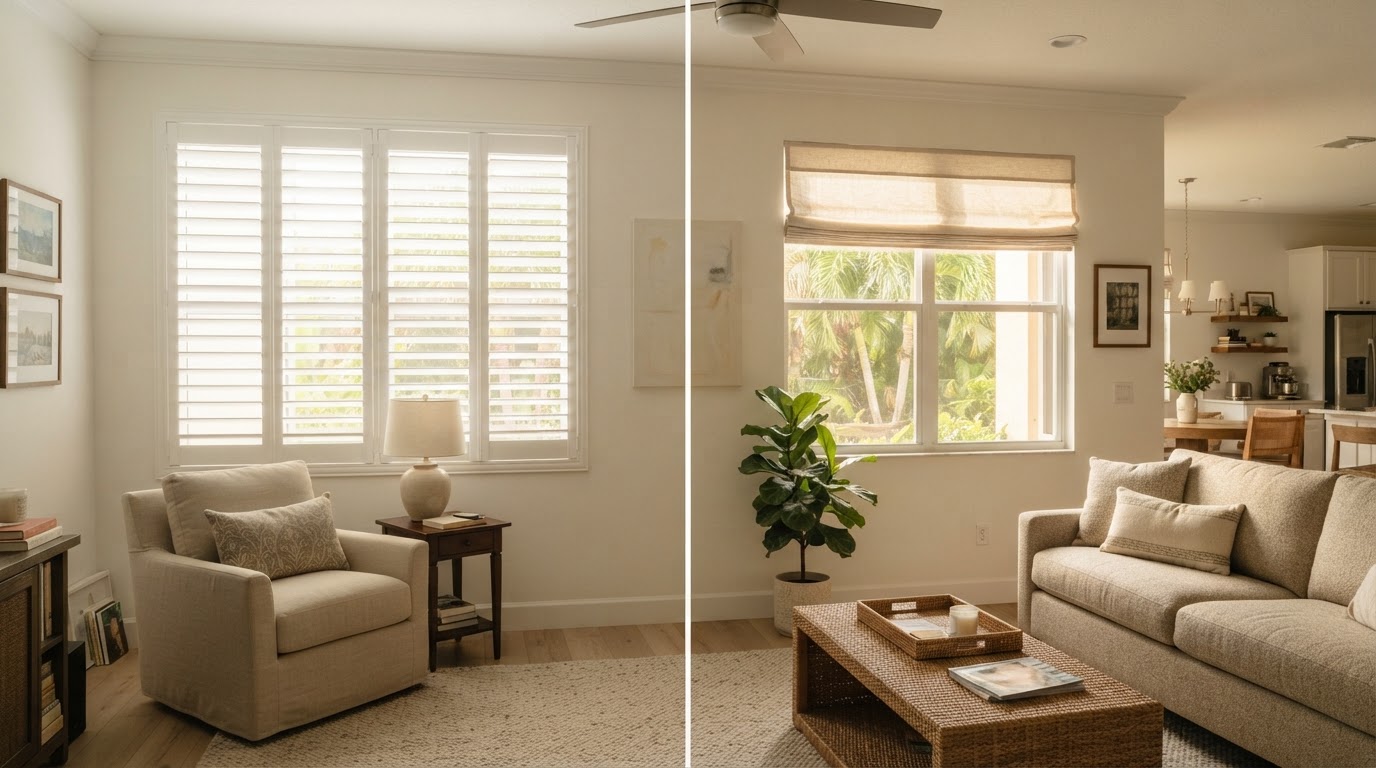
Plantation Shutters vs. Shades for Florida Homes
If you are trying to decide between plantation shutters and shades, the right choice often comes down to the way you want the room to look, feel, and function every day. Plantation shutters provide adjustable louvers and a built-in architectural appearance. Shades offer a wider range of fabrics, light-control levels, operating styles, and motorized options. This guide explains the tradeoffs so you can compare both choices based on Florida sunlight, privacy, window size, room design, and daily use.
The Quick Answer
Choose plantation shutters when you want a durable, furniture-like treatment with precise louver control and a permanent architectural appearance.
Choose shades when you want softer materials, more fabric choices, stronger room-darkening options, view-preserving solar fabrics, or motorized operation.
Shutters often work well in living rooms, bedrooms, dining rooms, bathrooms, and street-facing spaces where privacy and adjustable light matter. Shades may be a better fit for wide windows, sliding glass doors, hard-to-reach openings, bright rooms, coastal views, and spaces where fabric texture or automation is important.
Neither option is best for every Florida home. The better choice depends on the room, window dimensions, sunlight, humidity, privacy needs, design preferences, and budget.
| Factor | Plantation Shutters | Shades |
|---|---|---|
| Appearance | Built-in and architectural | Soft, minimal, or decorative |
| Light control | Adjustable louvers | Depends on fabric and shade style |
| Privacy | Strong when louvers are closed | Varies by fabric and opacity |
| Outdoor view | Partially preserved through open louvers | Solar fabrics may preserve more |
| Room darkening | Reduces light but is not blackout | Room-darkening and blackout options may be available |
| Large windows | Requires appropriate panel design | Many product and configuration choices |
| Sliding doors | Possible with specialized panel systems | Roller, panel, cellular, and motorized options |
| Motorization | Less common for standard shutter louvers | Available on many shade products |
| Maintenance | Hard surfaces can be dusted or wiped | Care depends on the fabric |
| Design flexibility | Frame, louver, color, and panel choices | Wide range of fabrics, colors, textures, and controls |
What Are Plantation Shutters?
Plantation shutters are fitted window treatments made with framed panels and adjustable louvers.
The louvers can be tilted to control natural light, reduce direct views into the room, or close for stronger privacy. Depending on the window and shutter design, the panels may also swing open.
Shutters become a prominent part of the window and often create a built-in, furniture-like appearance. They may be considered for living rooms, bedrooms, dining rooms, home offices, bathrooms, street-facing windows, specialty-shaped windows, and rooms where architectural detail matters.
Main Benefits
- Adjustable natural light
- Strong privacy control
- A built-in appearance
- Clean lines
- Durable hard-surface construction
- Coordination with trim and interior architecture
- Partial-window configurations where appropriate
- Fewer fabric-care concerns
- Precise louver adjustment throughout the day
Possible Drawbacks
- A larger visual presence at the window
- Less fabric, color, and texture variety than shades
- Space requirements for panels to open
- Careful planning around furniture and window handles
- Potentially higher project cost than some shade options
- Partial obstruction of the glass from frames and panels
- Specialized configurations for very wide doors or openings
- No true fabric-style blackout effect
Explore plantation shutters, plantation shutters in Jacksonville, and Norman plantation shutters.
What Are Window Shades?
Shades use fabric, woven material, or specialized cellular and screen-like materials to cover the window. Depending on the style, shades may roll, fold, stack, raise, lower, or move from side to side.
Available options may include roller shades, solar shades, cellular shades, Roman shades, woven wood shades, light-filtering shades, room-darkening shades, motorized shades, and specialty shades for wide openings. Shades can range from highly minimal to richly decorative.
Main Benefits
- A large selection of fabrics and textures
- Light-filtering and room-darkening choices
- Solar fabrics for glare and view control
- Options for wide and tall windows
- Manual and motorized controls
- Softer visual styling
- Coordination across several window sizes
- Layering with decorative panels or drapery
- Flexible privacy levels
- Cleaner solutions for some sliding doors
Possible Drawbacks
- Privacy that varies by fabric
- Care requirements that depend on material
- Fabric movement near open doors or strong airflow
- Product limits on very large shades
- Alignment considerations when multiple shades share one opening
- More frequent operation than fixed shutters
- Potential charging or power planning for motorized products
- Some fabrics allowing shapes or shadows after dark
Explore custom shades, roller shades, cellular shades, and motorized shades.
Which Option Provides Better Light Control?
Both shutters and shades can control light, but they do it differently.
Plantation shutters use adjustable louvers. Tilting the louvers allows homeowners to redirect daylight, reduce glare, and change the room's privacy throughout the day.
Shades control light through the selected fabric and how much of the window is covered. A light-filtering shade can soften the room without making it dark. A solar shade can reduce glare while preserving more of the outdoor view. A room-darkening fabric can reduce more light when that is the priority.
Choose shutters when you want adjustable hard-surface louvers. Choose shades when you want the fabric itself to determine the amount and quality of light entering the room.
Which Option Provides Better Privacy?
Plantation shutters can provide strong privacy when the louvers are closed. They also allow homeowners to change the louver angle as privacy needs shift throughout the day.
Some shutter configurations may allow the upper and lower louvers to move separately. Where supported, this can bring in daylight from above while keeping the lower portion of the window more private.
Shade privacy depends heavily on the fabric. Light-filtering and cellular shades may provide good daytime privacy. Room-darkening and more opaque fabrics may provide stronger coverage. Solar shades often provide less reliable nighttime privacy because visibility can increase when the room is brighter than the outdoors.
When privacy is the main concern, consider whether the room is used after dark, street and sidewalk distance, neighbor visibility, window height, fabric opacity, louver angle, gaps around the treatment, and whether layering is needed.
Learn more about choosing privacy window treatments without making rooms dark.
Which Option Is Better for Bright Florida Rooms?
The better option depends on whether the homeowner wants adjustable light, glare reduction, view preservation, or stronger room darkening.
Shutters can redirect sunlight by changing the louver angle. This may help control bright light without covering the entire window with fabric.
Solar shades may be more appropriate when glare and view preservation are the main concerns. Light-filtering shades can create a softer glow, while room-darkening fabrics can reduce more light.
For bright rooms, consider which direction the window faces, morning versus afternoon sun, television or computer glare, furniture and flooring exposure, window size, outdoor view, privacy after dark, and whether the room should remain visually open.
Explore window treatments for bright living rooms, solutions for hot Florida rooms, and the comparison between solar and light-filtering shades.
Which Option Is Better for Florida Humidity?
Humidity should be considered along with the exact material and product specifications.
Some shutter materials are designed to work well in humid rooms, making them worth considering for bathrooms, kitchens, laundry rooms, and coastal homes. Fabric shades may also work in these spaces, but the material, proximity to water, ventilation, and cleaning requirements should be reviewed carefully.
Before selecting either product, consider distance from showers, tubs, and sinks, room ventilation, coastal air, how frequently the window is opened, manufacturer care guidance, ease of cleaning, and direct versus general humidity exposure.
Do not assume that every shutter is waterproof or that every shade is unsuitable for humid rooms. The recommendation should be based on the actual product and room conditions.
Which Option Looks More Built In?
Plantation shutters usually create the more permanent, architectural appearance. The frame and panels become part of the visual structure of the window. This can coordinate well with interior trim, built-in shelving, traditional architecture, coastal interiors, transitional rooms, and clean, tailored spaces.
Shades generally feel softer and less structural. Roller and solar shades may nearly disappear when raised. Roman and woven shades can add decorative texture. Cellular shades provide a clean fabric appearance without the hard lines of a shutter frame.
Choose shutters when the window treatment should feel like part of the architecture. Choose shades when you want softness, fabric, minimalism, or greater decorative variety.
Which Option Preserves More of the Outdoor View?
Shades—especially solar shades—may preserve more of the outdoor view when lowered. The amount of visibility depends on fabric openness, fabric color, and the difference between indoor and outdoor lighting.
Shutters preserve the view when the louvers or panels are open, but the frame, louvers, and panels remain visible at the window.
For homes with water, pool, golf-course, preserve, or patio views, consider how much of the view should remain visible, whether glare is also a concern, daytime and nighttime privacy, window width, how much frame or fabric you want to see, and whether the treatment should disappear when open.
Solar shades can be useful where the view matters, but they should not be treated as guaranteed nighttime privacy.
Explore window treatments for coastal homes and guidance for Jacksonville Beach coastal light.
Which Option Is Better for Room Darkening?
Shades generally provide more room-darkening choices. Room-darkening and blackout fabrics may be available for roller, cellular, Roman, and other shade styles. Even then, light may still enter around the edges unless the system is specifically designed to limit those gaps.
Plantation shutters can reduce a substantial amount of light when closed, but standard shutters should not be described as blackout products. Light may enter around louvers, frames, and panels.
For bedrooms, nurseries, media rooms, or shift-work schedules, consider fabric opacity, edge gaps, window depth, outside versus inside mounting, layered treatments, morning sunlight, and the level of darkness actually needed.
Explore bedroom window treatments for privacy and light control.
Which Option Is Easier to Maintain?
Plantation shutters have hard surfaces that can typically be dusted and wiped according to the product's care instructions. Their frames and louvers require routine dusting, but there is no fabric to wash or vacuum.
Shade maintenance depends on the material. Some roller and solar fabrics may be relatively simple to dust or gently clean. Textured, woven, or softer fabrics may require more careful maintenance.
Consider dust exposure, children and pets, kitchen residue, humidity, allergies, fabric texture, manufacturer care guidance, and ease of reaching the treatment. No product is maintenance-free, but the preferred care routine may help determine which option fits the household.
Which Option Is Better for Large Windows?
Large windows require attention to product weight, panel size, operation, and how often the treatment will be adjusted. Shutters may require several panels or a carefully planned configuration across a wide opening. Shades may use one large treatment or several smaller shades. Dividing the opening may reduce weight and allow more flexible light control.
For large windows, consider total width and height, panel or fabric weight, product size limits, number of sections, manual versus motorized operation, view preservation, symmetry, furniture placement, and how often the treatment will move.
Motorized shades may be useful for tall or frequently adjusted windows. Explore custom window treatments for large openings, motorized shades, and solutions for hard-to-reach windows.
Which Option Is Better for Sliding Glass Doors?
Shades often provide more layout choices for sliding glass doors. Options may include roller shades, solar shades, panel-style treatments, vertical cellular systems, motorized shades, and multiple shades across one opening.
Plantation shutters may also work on some sliding doors using bypass or folding panel systems. However, the panels require careful planning around access, stacking space, handles, and nearby furniture.
For a frequently used door, consider which panel moves, how often the door opens, side-to-side access, patio or pool traffic, children and pets, view preservation, nighttime privacy, and available stacking space.
Explore the complete guide to window treatments for large sliding glass doors.
Best Choice by Room
Best Choice for Living Rooms
Both plantation shutters and shades can work well in living rooms.
Shutters may fit when you want:
- An architectural appearance
- Adjustable louvers
- Strong privacy
- Coordination with trim
- A tailored, finished look
Shades may fit when you want:
- Softer fabric
- Glare reduction
- A preserved outdoor view
- Motorized controls
- More decorative colors and textures
Best Choice for Bedrooms
Bedrooms often need privacy and stronger control over early morning or late afternoon light. Shutters provide adjustable privacy and light control but should not be treated as blackout products. Shades provide more fabric-opacity choices, including light-filtering, room-darkening, and blackout materials where available.
Homeowners who prefer the appearance of shutters but need stronger darkness may consider layering them with drapery or another compatible treatment. Explore bedroom window treatments for privacy and light control.
Best Choice for Bathrooms
Bathrooms require privacy, humidity planning, and easy maintenance. Shutters made from materials suitable for humid areas may be a strong choice because they provide adjustable light and privacy with a hard surface. Suitable shades may also work, depending on the material, ventilation, and distance from water.
Consider window height, street visibility, distance from showers and tubs, ventilation, nighttime use, manufacturer specifications, and cleaning requirements.
Best Choice for Home Offices
Home offices need glare control, privacy, and natural light. Shutters may work well when adjustable louvers and a polished background are priorities. Solar or light-filtering shades may work better when screen glare or preserving the outdoor view matters most.
Motorized shades may be useful for windows behind desks, high windows, or groups of windows adjusted several times a day. Explore motorized shades and solutions for hard-to-reach windows.
Best Choice for Coastal Homes
Coastal homes often feature large windows, open views, bright sunlight, and humidity. Shutters can provide a tailored coastal appearance and adjustable privacy. Material selection should reflect the room conditions and manufacturer guidance.
Solar shades may be preferable where glare control and preserving a water, patio, or landscape view matter most. Light-filtering shades may work better in bedrooms and other rooms where privacy and softness matter more than the view. Explore window treatments for coastal homes and Jacksonville Beach coastal light.
How to Choose Between Plantation Shutters and Shades
Choose Plantation Shutters When
- You prefer a built-in architectural appearance
- Adjustable louvers are important
- You want strong privacy control
- You prefer hard surfaces over fabric
- The treatment should coordinate with trim
- The room benefits from a tailored, permanent look
- Motorization is not the primary goal
Choose Shades When
- You want more fabric and texture choices
- Glare control is a priority
- You want to preserve an outdoor view
- Stronger room-darkening is needed
- The window is large or hard to reach
- Motorized operation is important
- You prefer a softer or more minimal appearance
- The opening is a sliding glass door
Consider Combining Treatments When
- You want the architectural appearance of shutters with decorative softness
- The room needs adjustable light and stronger evening privacy
- One product cannot meet every design and performance need
- Decorative panels would help finish the room
- Different windows in the home need different solutions
You do not have to use the same treatment in every room.
Can Plantation Shutters and Shades Be Used in the Same Home?
Yes. Using shutters and shades in the same home can create a more practical room-by-room plan.
For example:
- Shutters in street-facing living rooms
- Light-filtering shades in dining rooms
- Room-darkening shades in bedrooms
- Faux wood or suitable shutters in humid rooms
- Solar shades in bright offices
- Motorized shades on tall windows
- Wide-opening shades on sliding doors
The home can still feel coordinated by repeating colors, finishes, and design details across different product types.
How Much Do Plantation Shutters and Shades Cost?
Pricing depends on the product, material, window dimensions, number of openings, controls, installation, and custom features. Plantation shutters and shades use different construction and operating systems, so the final project cost should be compared using the actual windows and selected products.
Cost factors may include:
Do not choose based on product category alone. Product quality, window size, control options, and installation can significantly affect the final project.
Frequently Asked Questions
Helpful answers for homeowners comparing shutters and shades.
Compare Plantation Shutters and Shades in Your Home
Schedule a free in-home consultation to compare shutters, shades, fabrics, louvers, and control options in your actual space. The goal is to help each room feel private, comfortable, and easy to enjoy.