
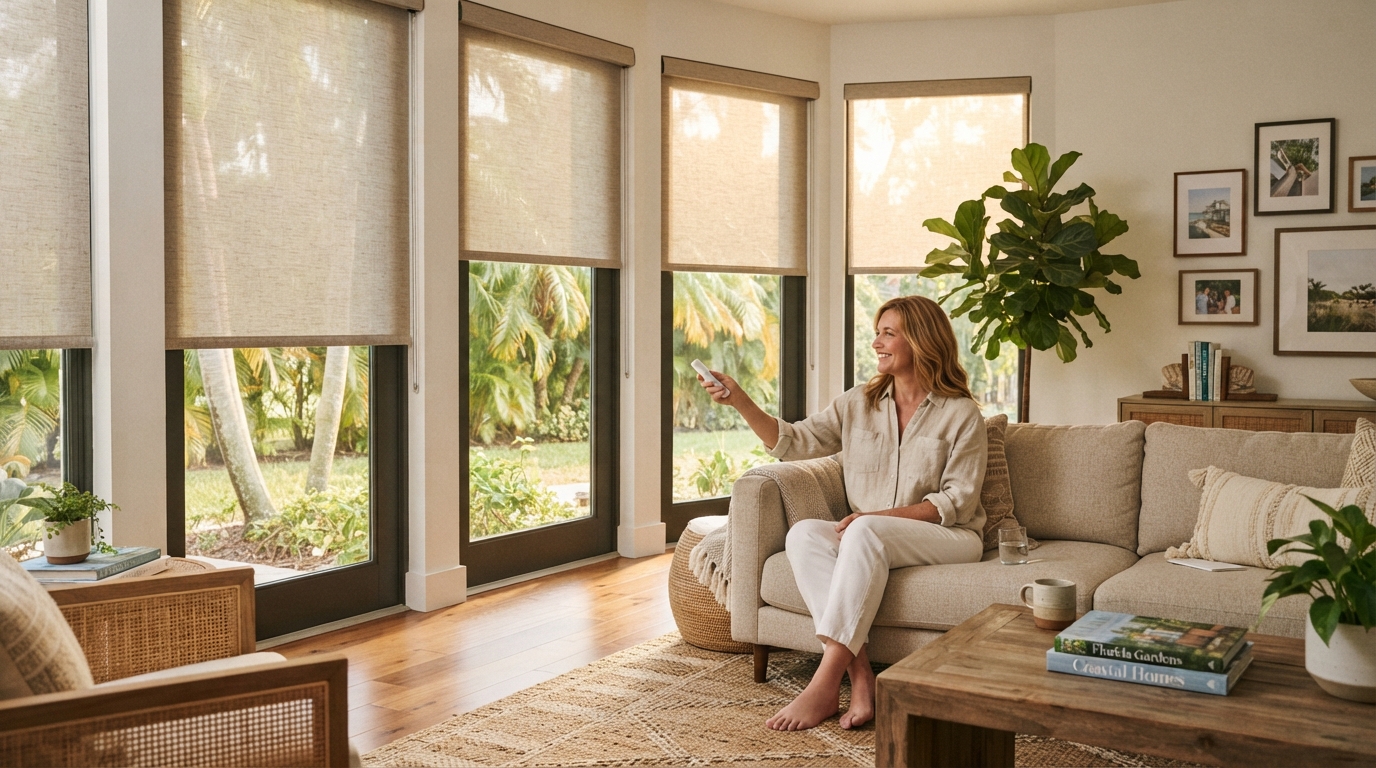
Motorized Shades vs. Manual Shades: Which Is Better for Your Home?
Manual shades are usually the better choice for smaller, easy-to-reach windows where simplicity and lower upfront cost matter most. Motorized shades tend to make more sense for large or hard-to-reach windows, rooms where shades need frequent adjustment, and homeowners who want grouped, scheduled, remote, or smart-home control. For many Jacksonville-area homes, the best answer is not choosing one system for every window — it is using motorization where it solves a real problem and keeping other windows manual.
The Quick Answer
Choose manual shades when the windows are easy to reach, the shades are adjusted only once or twice a day, and keeping the project simple is the main goal. Choose motorized shades when the windows are large, tall, behind furniture, hard to reach, or adjusted often. Motorization may also be useful when several shades need to move together or follow a daily schedule.
Manual Shades
- Easy-to-reach windows
- Lower upfront cost
- Simple operation
- No power source needed
- Best when shades move infrequently
Motorized Shades
- Tall or hard-to-reach windows
- Large or heavy shades
- Several shades operating together
- Frequent glare or privacy adjustments
- Scheduled or remote control
| Factor | Manual Shades | Motorized Shades |
|---|---|---|
| Upfront cost | Lower | Higher |
| Ease of use | Simple for reachable windows | Easier for large or high windows |
| Daily convenience | Requires manual adjustment | Remote, app, switch, or scheduled control |
| Power source | Not needed | Battery, rechargeable, wired, or other system |
| Large windows | May become harder to operate | Often easier to manage |
| Hard-to-reach windows | Less practical | Stronger fit |
| Smart-home use | Not available | May be available |
| Maintenance | Simpler | Includes controls and power components |
| Best fit | Basic daily use | Convenience and frequent control |
Manual Shades
Lower cost · Simple for reachable windows · No power needed · Simpler maintenance
Motorized Shades
Higher cost · Easier for large or high windows · Battery, wired, or rechargeable · May support smart-home control
Motorization is not necessary for every room. Its value depends on whether it solves a real access, size, privacy, glare, or convenience problem.
The Jacksonville Motorization Test
Before paying extra for motorization, ask five questions.
1Reach
Hard to access?
Tall foyer windows, windows above stairs, windows behind furniture, and openings above tubs or built-ins can make manual operation inconvenient or unrealistic.
2Sun
Strong afternoon glare?
This matters especially in west-facing Jacksonville rooms where low-angle afternoon sun can become difficult to manage later in the day.
3Size
Large or multiple shades?
The larger the opening and the more shades involved, the more valuable grouped or powered control can become.
4Routine
Adjusted several times a day?
If the shade opens in the morning, lowers for afternoon glare, and closes again for privacy, motorization may remove a repetitive daily task.
5Automation
Would schedules or grouping help?
If the answer is no, manual operation may still be the better value.
Your Result
0–1 Yes
Manual may be enough.
2–3 Yes
Compare both options.
4–5 Yes
Motorization deserves serious consideration.
The goal is not to add technology everywhere. It is to put motorization where it improves everyday use.
Not Sure Which Windows Are Worth Motorizing?
Compare manual and motorized options during a free in-home consultation.
Why Jacksonville Homes Can Be Different
Northeast Florida homes create several situations where motorization may be more useful than it would be on a standard, easy-to-reach window.
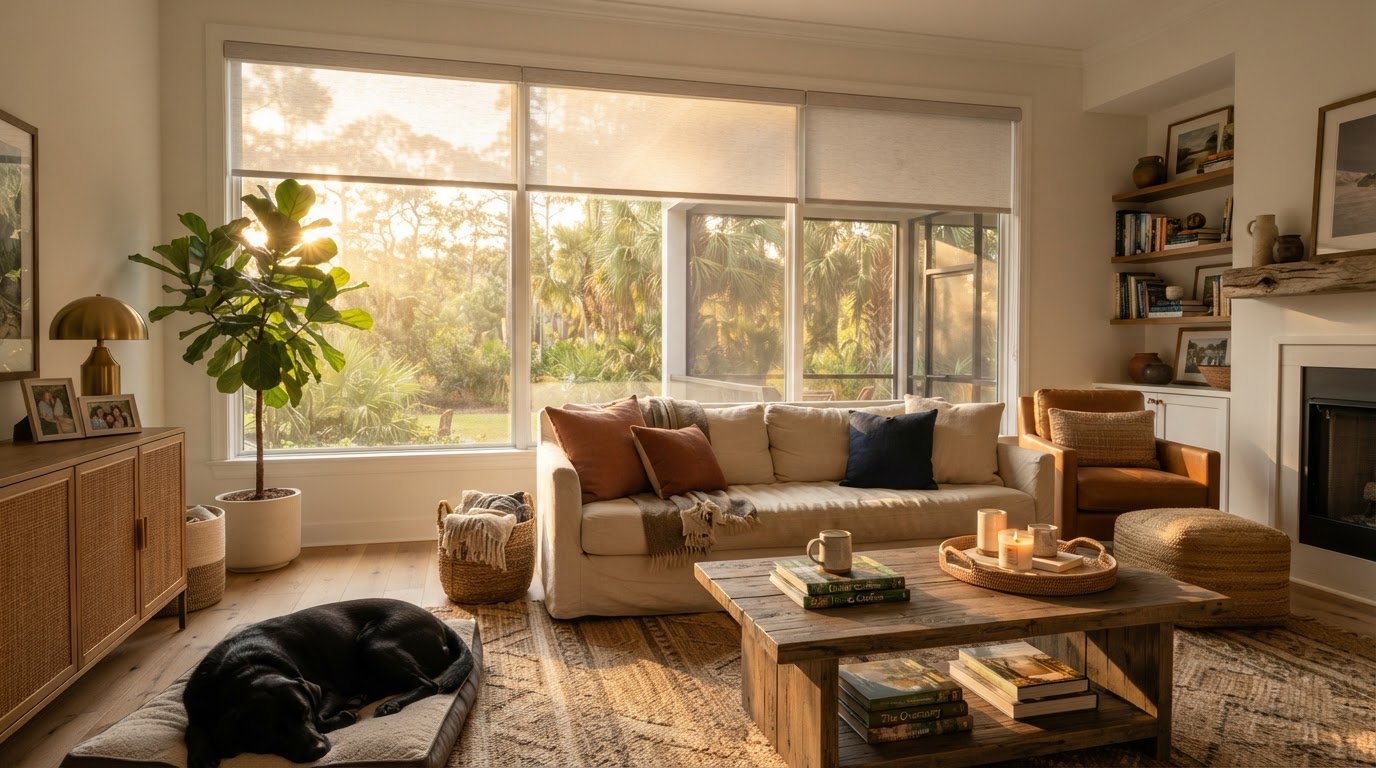
West-facing rooms can benefit from scheduled shade adjustments when afternoon glare becomes difficult to manage.
West-Facing Rooms
Problem:
Late-afternoon sun and glare.
Why motorization may help:
Scheduled shades can lower before the strongest sunlight reaches the room and raise again later if desired. For a room where sunlight changes how comfortable or usable the space feels, it can matter quite a bit.
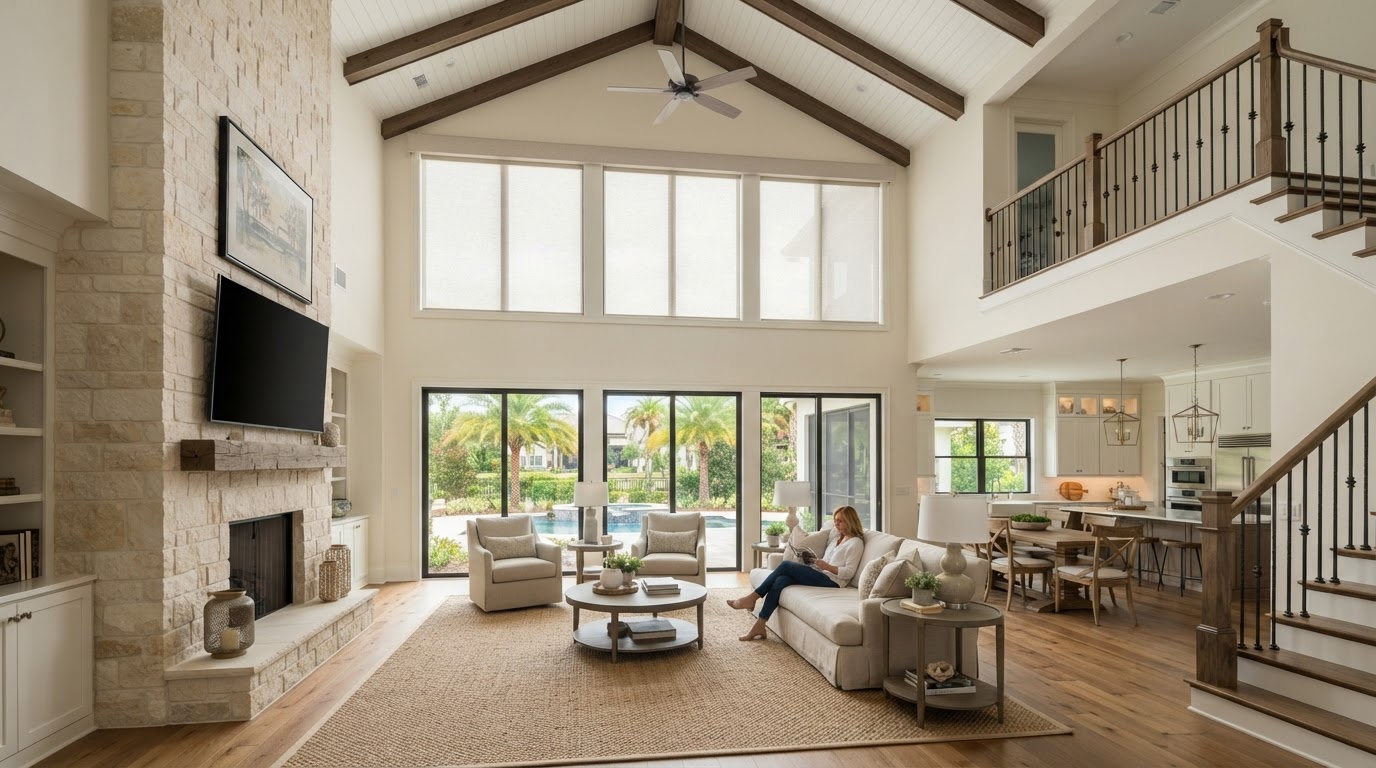
For high windows and two-story spaces, motorization can solve an access problem—not just add convenience.
Two-Story & Hard-to-Reach Windows
Problem:
Manual access may be difficult or impractical.
Why motorization may help:
It removes the need for repeated physical access. Some Jacksonville-area homes have two-story great rooms, tall foyer windows, stairwell glazing, transom windows, clerestory windows, windows above tubs, and openings behind furniture or built-ins.
In these locations, motorization solves more than a convenience problem. It solves an access problem.
A beautiful shade does little good if the homeowner avoids operating it because reaching the window is difficult. Explore shades for hard-to-reach windows.
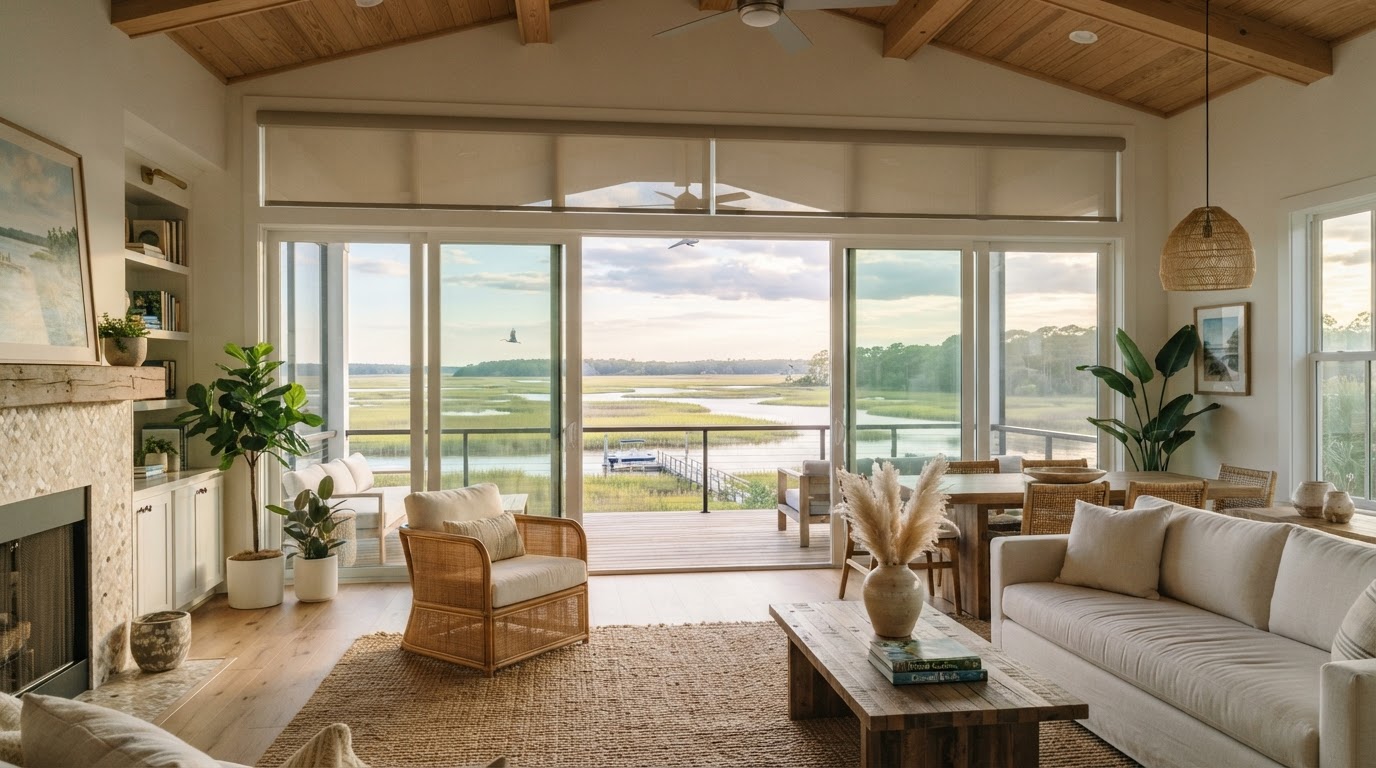
In waterfront homes, shades can help manage glare while still making it easy to reopen the view when conditions change.
Coastal, Intracoastal & Riverfront Homes
Problem:
Large glass openings and changing glare while preserving views.
Why motorization may help:
Shades can be lowered during difficult light and reopened later. The homeowner may want the shade lowered during periods of strong glare but raised again when the light changes so the view remains part of the room. Motorization can make those transitions easier, especially when several large shades need to move together.
Large Sliding Doors & Window Walls
Problem:
Large or heavy treatments may be cumbersome to adjust.
Why motorization may help:
Grouped control can simplify operation. Motorization becomes more useful when the treatment is wide or heavy, several shades cover one opening, the door receives strong sun, privacy changes throughout the day, or the shades are adjusted frequently.
Smart-Home-Oriented Homes
Problem:
Homeowners may already manage lighting, security, climate, or other systems digitally.
Why motorization may help:
Compatible shades may fit into the same routine. This can be particularly relevant in newer Jacksonville-area communities where homeowners are already thinking about home automation. Compatibility varies by manufacturer, motor, hub, and platform, so smart-home integration should be planned before the shades are ordered.
What Are Manual Shades?
Manual shades are raised, lowered, or adjusted by hand.
Depending on the product, they may use a cordless lift, handle, chain, or another approved control system. They are often the simplest choice for standard windows that are easy to reach. Manual operation can work especially well when the shade stays in one position for most of the day, only one or two windows are involved, the opening is relatively small, or there is no need for scheduled or grouped control.
Main Advantages
- Lower upfront cost
- Simple operation
- No battery or wiring
- Fewer electronic components
- Practical for smaller windows
- Straightforward maintenance
⚠ Possible Drawbacks
- The window is large or the shade is heavy
- Furniture blocks access
- The window is tall or difficult to reach
- Several shades need to move together
- Privacy needs change from morning to night
- The homeowner wants scheduled control
Explore custom shades, roller shades, cellular shades, and woven wood shades.
What Are Motorized Shades?
Motorized shades use a powered system to raise, lower, or position the shade.
Depending on the product, they may be controlled by remote, wall switch, app, timer, or a compatible smart-home system. Motorization can be available with several shade styles, including roller, solar, and cellular products, depending on the manufacturer, fabric, dimensions, motor, and installation.
Main Advantages
- Easier control
- Better access to tall or wide windows
- Operate several shades together
- Convenient control behind furniture
- Daily schedules and preset positions
- Less repeated manual handling
⚠ Possible Drawbacks
- Higher upfront cost
- A required power source
- Battery charging or replacement
- More planning during installation
- Electronic parts may need service
- Access requirements for charging or repairs
Explore motorized shades, Norman motorized shades in Jacksonville, and solutions for hard-to-reach windows.
Which Option Is Better for Everyday Convenience?
The value of motorization often comes down to frequency. A manual shade may be perfectly easy to use when it stays in one position most of the day. A motorized shade may become more useful when it opens in the morning, lowers during afternoon glare, adjusts for television or computer use, closes after sunset for privacy, moves with several other shades, or changes position on a predictable daily schedule.
In a small guest room with one reachable window, manual operation may be all that is needed. In a living room with several tall west-facing windows, motorization can solve a much more meaningful daily problem.
Which Option Costs Less?
Manual shades generally cost less because they do not include a motor, controls, power components, or smart-home equipment.
The better question is not simply which option costs less. It is where the added cost of motorization actually improves the room enough to be worthwhile. A tall shade that moves several times each day presents a very different value calculation than a small bathroom shade that stays halfway down most of the time.
Are Motorized Shades Worth It?
Short answer:
Motorized shades may be worth the added cost when they make a room easier to use every day — especially for hard-to-reach, large, or frequently adjusted windows.
Often Most Valuable When
- Windows are difficult to reach
- Shades move several times a day
- The opening is large or heavy
- Several shades should move together
- Scheduled control would help
- Furniture blocks access
Less Necessary When
- Windows are small and easy to reach
- Shades rarely move
- Only one shade is involved
- Remote or scheduled control is not important
- Simplicity is the priority
Motorization is most useful when it improves the way the room functions, not simply because the technology is available.
When We Would Not Push Motorization
Motorization can be a great solution, but it is not automatically the right upgrade for every window. We would look carefully at whether it creates enough everyday value to justify the added cost and complexity.
Manual shades may make more sense when:
- The window is small and easy to reach
- The shade rarely changes position
- There is only one simple opening
- The room does not have a meaningful glare problem
- Group control is unnecessary
- Smart-home control is not important
- Battery charging or electrical planning would add inconvenience
- The budget would be better spent on the right fabric, opacity, or product style
A well-chosen manual shade is better than motorization that does not solve a real problem.
Which Is Better by Room?
Large Windows
Short answer:
Motorization may make large shades easier to use, but the product still needs to stay within manufacturer limits.
Large shades can be heavier and more difficult to operate manually. In some cases, one wide opening may need to be divided into two or more shades.
- Shade width and height
- Fabric weight and motor capacity
- One large shade vs. several smaller shades
- Group control and door access
- Access for charging or service
Explore sliding glass door treatments, large-window options in St. Johns, and hard-to-reach solutions.
Hard-to-Reach Windows
Short answer:
Motorized shades are usually the stronger option when everyday manual access would be difficult or unsafe.
Common examples include tall windows, stairway windows, windows above tubs, windows behind sofas or desks, high windows in open living rooms, and windows above cabinets or built-ins.
The installation should also allow practical access for:
- Charging and battery replacement
- Programming and testing
- Future service
Explore shades for hard-to-reach windows.
Bedrooms
Motorized shades can be useful when privacy and light control follow a daily routine — opening in the morning, closing during afternoon sun, and lowering at night. Especially helpful when windows are behind a bed or dresser, several shades need to move together, or room-darkening shades are large or heavy.
Explore bedroom privacy and light control and privacy without making a room feel dark.
Living Rooms
Living rooms often have larger windows, outdoor views, television glare, and multiple shades in one space. Motorization may be especially useful when the room has west-facing windows, television glare changes during the afternoon, several shades should stay aligned, furniture blocks access, or the homeowner wants a repeatable daily schedule.
Explore bright living room treatments, hot Florida rooms, and protecting floors and furniture.
Home Offices
Home offices may need shade adjustments throughout the day as glare moves across computer screens. Motorized solar or roller shades can make those adjustments easier, especially when several windows are involved, glare changes during the afternoon, or windows are behind a desk.
Explore solar vs. light-filtering shades and roller shades.
Sliding Glass Doors
Large doors may benefit from motorization when the treatment is wide, heavy, or adjusted often. Useful when the shade covers a broad opening, the door receives strong sunlight, privacy changes throughout the day, or furniture makes manual operation awkward. Manual options may still work with vertical blinds, panel-style treatments, or smaller shade sections.
Explore sliding glass door treatments.
Older Adults or Limited Mobility
Motorized shades may reduce the need to reach, pull, bend, or move around furniture. Remote and wall-switch controls may be easier for some people than app-only systems. Motorization should not be presented as a medical or safety guarantee — it is an access and convenience option that may help depending on the individual and installation.
What About Child-Safe Window Treatments?
Cordless window treatments are an important consideration in homes with young children. Motorized shades remove the need for an everyday operating cord, which can make them an attractive option in nurseries, playrooms, bedrooms, and family spaces.
However, motorization is not the only cordless option. Many manual shades are also available with cordless operating systems. The right choice depends on the product, window height, room use, and how easily the shade can be reached.
Power Options for Motorized Shades
Motorized shades can use different power sources. The best choice depends on the number of shades, window location, access, and whether electrical work is practical.
Battery-Powered
Best fit: Existing homes
May be easier to add because they often do not require direct wiring.
Consider: battery replacement, motor access, frequency of use, shade size, and manufacturer guidance.
Rechargeable
Best fit: Retrofit convenience
Can reduce disposable battery use.
Consider: charging access, routine, battery-level awareness, and cable access. Charging frequency varies by product and usage.
Hardwired
Best fit: New builds & remodels
Provides continuous power.
Often considered during new construction, major remodeling, electrical upgrades, or large multi-window projects. May require electrical planning.
Plug-In
Best fit: Nearby outlet
May work where a suitable outlet is nearby.
Cord placement should be planned carefully so the installation remains neat and practical.
Not every power option is available on every product.
Do Motorized Shades Need Wiring?
Short answer:
Not always. Some systems use replaceable batteries, some use rechargeable batteries, some plug into an outlet, and others can be hardwired.
The best power option depends on the shade, motor, window location, access, and how the homeowner plans to use the system.
For existing homes, battery or rechargeable options may avoid the need for additional wiring. For new construction or major renovations, hardwired power may be worth discussing before the walls are finished.
Remote, App, Switch, or Smart-Home Control?
Motorized shades may offer several control options. Availability depends on the manufacturer, motor, and product.
Remote Control
Remote controls are simple and familiar for daily use. They may operate one shade, several shades, a room group, or multiple preset positions.
Wall Switch
A wall switch keeps control in a fixed location. Useful when the homeowner does not want to keep track of a remote, several shades are used in one room, or a consistent control location is preferred.
App Control
App control may allow individual shade control, room-by-room control, group control, schedules, and preset positions. Compatibility and available features vary.
Timers and Schedules
Schedules may open or close shades at regular times. Examples include:
- Opening bedroom shades in the morning
- Lowering west-facing shades before afternoon sun
- Closing living-room shades after sunset
- Adjusting several rooms on a routine
Smart-Home Integration
Some motorized shades may connect with compatible smart-home platforms. Compatibility depends on motor, hub, platform, network setup, manufacturer support, and installation configuration.
Do not assume every product works with every smart-home system.
Can Motorized Shades Help Manage Jacksonville Sun?
Motorization does not make shade fabric more effective by itself. Its advantage is making it easier to put the shade in the right position at the right time. For example, a west-facing shade may be scheduled to lower before strong late-afternoon sunlight begins creating glare in the room.
Motorized control may be useful for afternoon glare, large living-room windows, home offices, coastal views, sliding glass doors, rooms that become uncomfortable later in the day, and multiple windows that need coordinated control.
The exact effect depends on the shade material, fabric openness, window glass, orientation, installation, and other conditions. Motorized operation can improve consistency, but specific temperature or energy savings should not be assumed.
Explore hot Florida rooms, solar vs. light-filtering shades, and glare-control for Nocatee homes.
Which Is More Reliable?
Manual shades have fewer powered components. Motorized shades add a motor, controls, a power source, programming, and possible smart-home components. High-quality motorized products can be dependable, but batteries, remotes, and electronic components may require attention over time.
Product quality, correct sizing, proper installation, and manufacturer support matter for both types. Reliability should be judged by the entire system, not simply whether the shade is powered.
Which Is Easier to Maintain?
Manual Shades
- No charging or batteries
- No app setup or remote management
- Routine fabric care
- Occasional inspection of the manual control
Motorized Shades
- The same fabric care as manual shades
- Battery charging or replacement where applicable
- Remote batteries and app or connection setup
- Access for service and occasional testing
Manual shades are simpler to maintain. Motorized shades trade some added setup and power management for greater everyday convenience.
Can Existing Manual Shades Be Motorized Later?
Sometimes, but not always. Whether an existing manual shade can be converted depends on shade type, headrail or roller tube, dimensions, motor compatibility, manufacturer, available power source, and product age and condition.
In some cases, retrofitting may be possible. In others, replacing the existing shade with a motor-ready product may make more sense. If motorization may be important later, it is worth discussing that possibility when the shades are originally specified.
What Happens During a Power Outage?
Short answer:
It depends on the power source. Battery and rechargeable systems may continue operating while battery power remains available. Hardwired systems may stop operating if household power is unavailable.
Manual override capabilities also vary by product. This is a good question to ask before choosing a motor or power system, especially for shades that will be installed in difficult-to-reach locations.
Can Manual and Motorized Shades Be Mixed?
Short answer:
Yes. A hybrid approach is often one of the most practical ways to use motorization. High-use or difficult windows can be motorized while simple, reachable windows remain manual.
Motorized Shades May Make Sense In
- Living rooms and primary bedrooms
- Tall windows and large openings
- Sliding doors and home offices
- Windows behind furniture
- West-facing rooms needing frequent adjustment
Manual Shades May Be Practical In
- Guest rooms and bathrooms
- Smaller bedrooms
- Standard reachable windows
- Rooms where shades move less often
Using both can help focus the budget where motorization delivers the most daily value. The home can still feel coordinated by using similar fabrics, colors, hem styles, hardware, fascias, and design details.
How to Decide
Choose Manual Shades When
- Windows are easy to reach
- Shades move only once or twice a day
- Lower cost is the main goal
- The window is small or standard size
- Smart-home control is not important
- Simplicity is preferred
Choose Motorized Shades When
- Windows are tall or hard to reach
- Shades are adjusted often
- Several shades should move together
- The window is large
- Furniture blocks access
- Scheduled or smart-home control is important
Use Both When
- Only some rooms need motorization
- The budget should focus on high-use windows
- Large windows need more convenience
- Smaller rooms can stay manual
- The homeowner wants a practical room-by-room plan
Frequently Asked Questions
Helpful answers for homeowners comparing motorized and manual shades.
Compare Manual and Motorized Shades in Your Home
There is no reason to motorize a window that works perfectly well manually. There is also little reason to struggle with a tall, heavy, blocked, or frequently adjusted shade when motorization can make the room easier to use.
Those Blind Guys is a family-owned Jacksonville-area window treatment company helping homeowners compare custom blinds, shades, shutters, and motorized window treatments based on the way each room is actually used.
During an in-home consultation, we can compare:
- Manual and motorized operation
- Shade styles, fabric, and opacity
- Power and control options
- Large-window considerations
- Smart-home compatibility where applicable
- Installation requirements
The goal is a practical room-by-room plan, not technology for technology's sake.
Call 904-944-9596